

The preceding modules supplied the frameworks; this final module supplies the integration, because frameworks accumulated without a method for combining them produce not strategy but a vocabulary for discussing it. The purpose here is to convert the analytical apparatus developed across the series into a repeatable process that yields a strategy document a product leader can defend to executives, communicate to teams, and revise as reality intervenes. The approach proceeds in the spirit of Rumelt (2011), whose insistence that real strategy consists of a diagnosis, a guiding policy, and coherent action serves as the spine onto which the frameworks attach, and it incorporates the AI transition not as a separate consideration but as a condition that shapes every step. What follows is an end-to-end walkthrough, a set of templates, a method for constructing the strategic narrative, and a decision tree for the choices a strategy must make.
The End-to-End Walkthrough
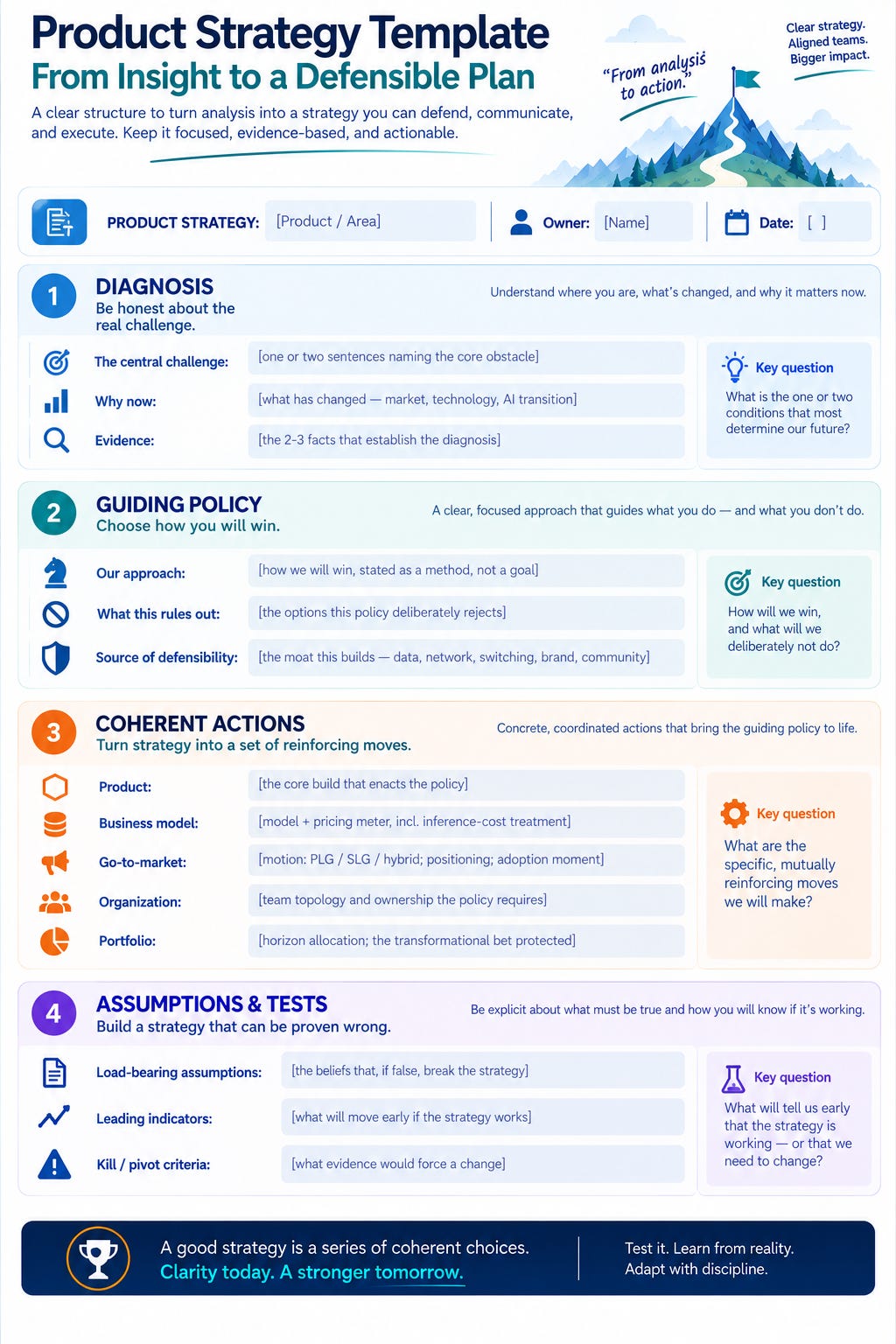
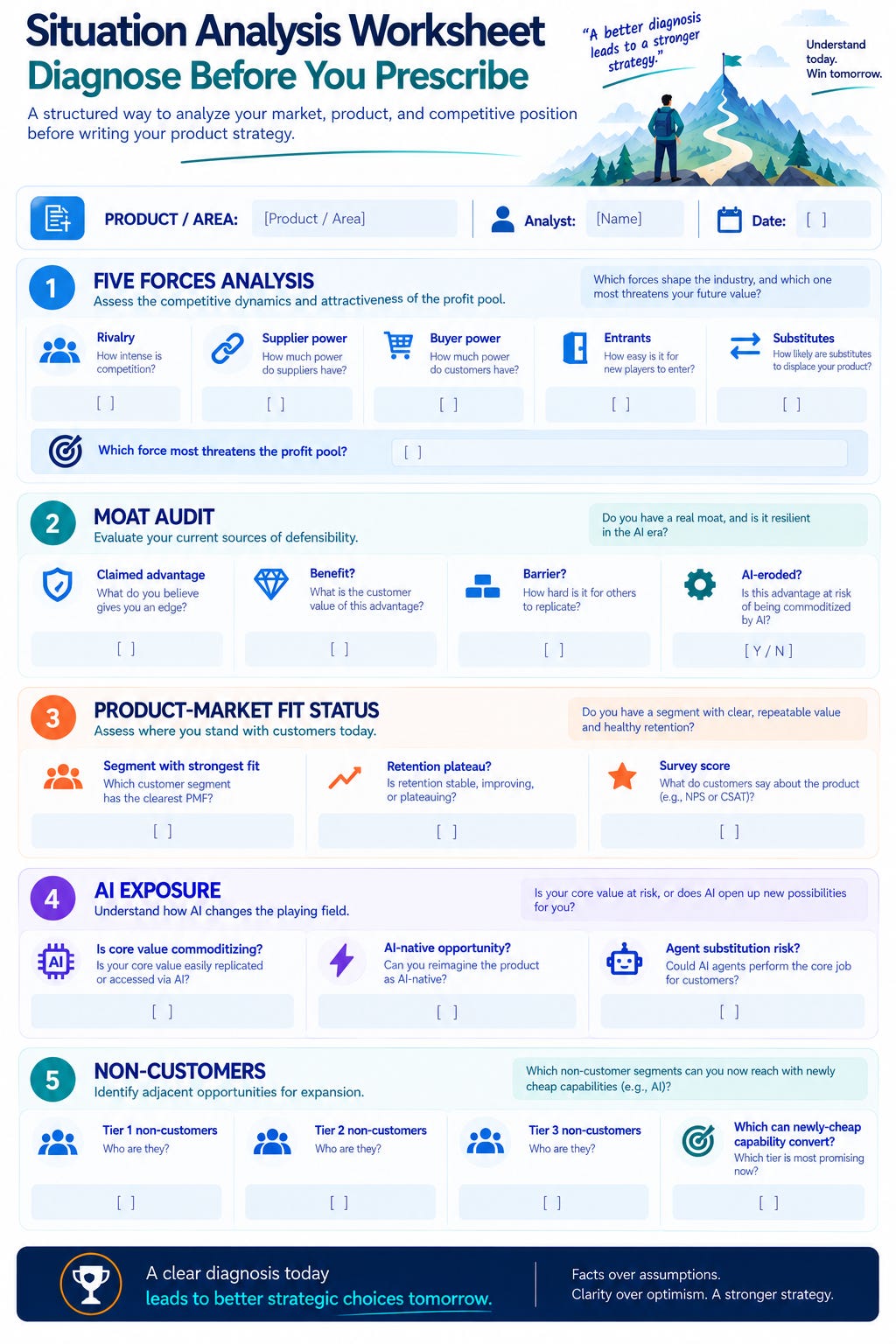
The process begins with diagnosis, the step organizations most often skip and the one Rumelt (2011) identifies as the irreducible core of strategy, in which the product leader states plainly the central challenge the product faces rather than the goals it aspires to. Diagnosis draws on the structural analysis of the Five Forces to characterize the profit pool and the competitive dynamics, on the assessment of moats to determine what defensibility the product holds and lacks, and on an honest reckoning with the AI transition to identify whether the product’s value rests on capability that is commoditizing. A diagnosis is complete when it names the one or two conditions that most determine the product’s future, since a diagnosis that lists everything has diagnosed nothing.
The process continues with the guiding policy, the overall approach chosen to address the diagnosed challenge, which is where the reframing frameworks earn their place, since the guiding policy frequently embodies a blue-ocean reconception of the market, a decision about which network effect or moat to build, or a choice of where on the AI-native to AI-enabled spectrum the product will sit. The guiding policy is not a goal but a method, expressing how the product will win rather than what it hopes to achieve, and its quality is tested by whether it rules things out, since a guiding policy compatible with every possible action is not guiding anything.
The process then specifies coherent action, the set of concrete, mutually reinforcing moves that enact the guiding policy, which is where prioritization, portfolio allocation, business model, pricing, go-to-market, and organizational design become the instruments of execution rather than separate concerns. Coherence is the demanding criterion here, since the actions must reinforce one another rather than merely coexist, and a strategy whose pricing fights its go-to-market or whose team structure contradicts its guiding policy will be ground down by its own internal friction. The walkthrough closes with the explicit articulation of the assumptions on which the strategy depends and the leading indicators that will reveal whether it is working, drawing on the uncertainty and metrics modules so that the strategy is built to be tested rather than merely asserted.
Templates
The following template structures the strategy document itself, designed to fit the one-page-narrative discipline while accommodating the depth a longer memo requires.
The second template supports the diagnosis step by structuring the situational analysis the document compresses, and it is completed before the document is written rather than after.
Constructing the Strategic Narrative
The strategic narrative is the prose that carries the strategy into the minds of the people who must act on it, and its construction follows the storytelling discipline of the leadership modules rather than the structure of the analytical worksheet. An effective strategic narrative opens from a situation the audience recognizes, introduces the tension that the diagnosis has identified, and arrives at the guiding policy as the natural resolution of that tension, so that the audience experiences the conclusion as discovered rather than asserted. The narrative anchors the abstract strategy in a concrete scene, frequently the experience of a specific customer in the future the strategy aims to create, since this is what converts the strategy from a proposition the audience evaluates into a future the audience can inhabit. The discipline of the narrative is intellectual honesty, since it must acknowledge the genuine uncertainties and the strongest objections and address them, which is what earns the trust of the skeptical executives whose conviction the strategy requires, and it must be compressible to the single page that makes it portable through the organization without the author present.
A Decision Tree for the Core Strategic Choices
The following decision tree organizes the sequence of choices a product strategy must make, ordering them so that each decision constrains the next, which is how a coherent strategy is built rather than assembled.
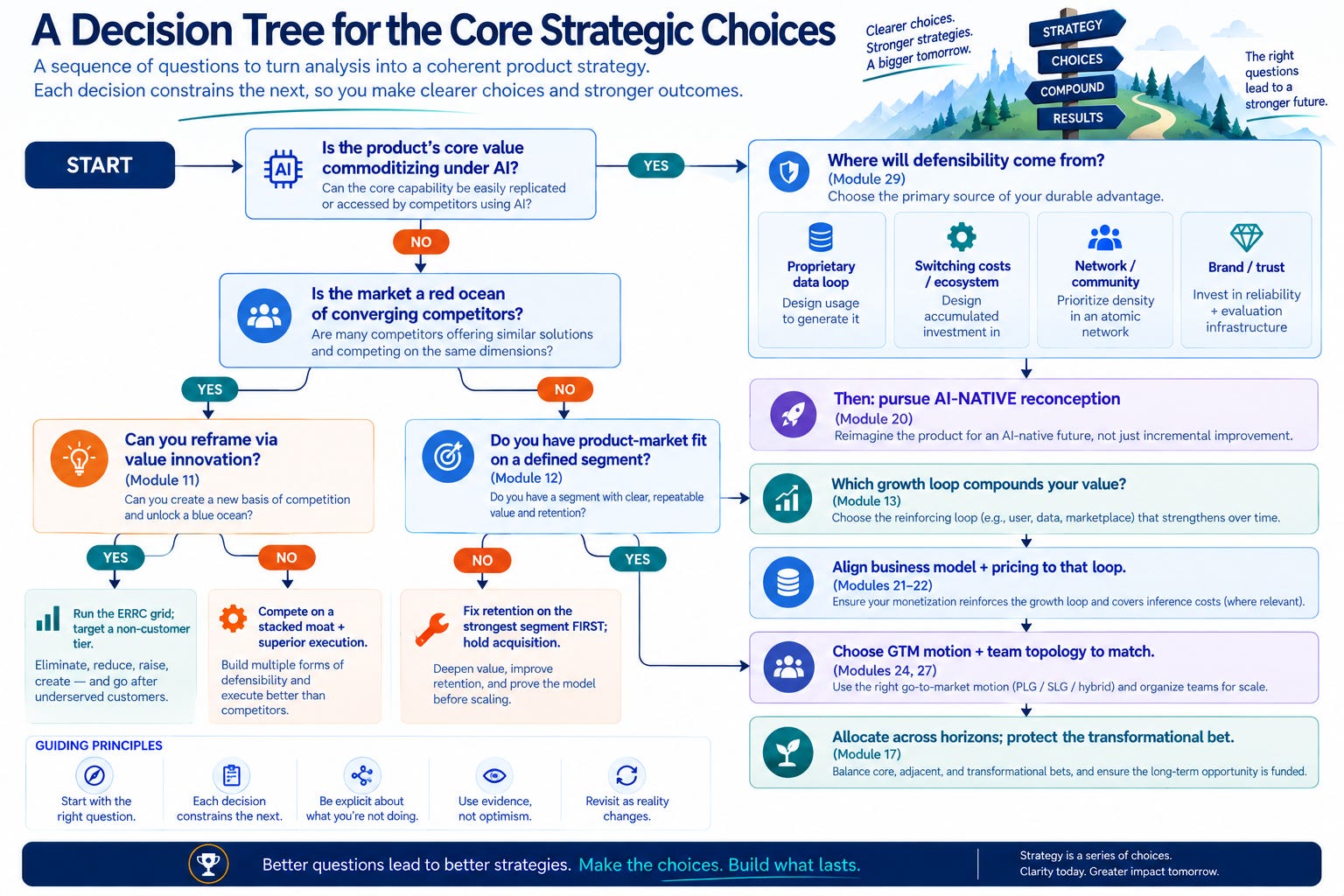
The tree is not a substitute for judgment but a scaffold for it, ensuring that the strategy addresses defensibility before growth, fit before scale, and the AI condition before everything else, which is the ordering the series has argued for throughout.
Closing the Series
The synthesis with which this series concludes is that product strategy is neither the application of a single favored framework nor the accumulation of many, but the disciplined integration of diagnosis, guiding policy, and coherent action, informed by the frameworks and grounded in the specific situation the product faces. The AI transition does not displace this discipline but intensifies it, since the commoditization of capability has raised the premium on genuine defensibility, the migration of work to agents has unsettled business models and category definitions, and the acceleration of change has made strategy under uncertainty the normal condition rather than the exception. The agenda for the product leader is to treat strategy as a document that is reasoned through rather than asserted, built on an honest diagnosis, expressed as a guiding policy that rules things out, enacted through coherent and mutually reinforcing actions, carried by a narrative that earns conviction, and held accountable to the assumptions and leading indicators that will reveal whether it is working. A strategy designed this way will sometimes be wrong, since the future is genuinely uncertain, but it will be wrong in ways the organization can detect and correct, which is the most that strategy can honestly promise and considerably more than most organizations achieve.
References
Lafley, A. G., & Martin, R. L. (2013). Playing to win: How strategy really works. Harvard Business Review Press.
Rumelt, R. P. (2011). Good strategy / bad strategy: The difference and why it matters. Crown Business.
Watkins, M. D. (2007). Demystifying strategy: The what, who, how, and why. Harvard Business Review. https://hbr.org/2007/09/demystifying-strategy-the-what